Nikkor 35mm f/1.4
Nippon Kogaku · Nikon F · 1970 · Retrofocus, with close-range correction
our own findingAlso known as: Nikkor-N Auto 35mm f/1.4 · Nikkor-N·C Auto 35mm f/1.4 · NIKKOR-N.C Auto 35mm 1:1.4 · New Nikkor 35mm f/1.4 · Ai Nikkor 35mm f/1.4 · Ai-S Nikkor 35mm f/1.4S · Nippon Kogaku Nikkor-N 35mm f/1.4 · ニッコール 35mm F1.4
Variants & identification
| Variant | Mount | Years | Serial ranges | Production |
|---|---|---|---|---|
| Nikkor-N Auto (Nippon Kogaku) | Nikon F | 1970–1971 | 350001–352697 | 2,697 (Vink, counted from serials — not a factory figure) |
| Nikkor-N Auto (Nikon) | Nikon F | 1971–1973 | 360001–368727 | 8,727 (Vink, serial-derived) |
| Nikkor-N·C Auto | Nikon F | 1973–1976 | 370001–377067 | 7,067 (Vink, serial-derived) |
| Nikkor-N·C Auto (NASA) | Nikon F | 1976–1976 | 1001–1019 (its own short block, restarting from 1001) | 19 (Vink, serial-derived) |
| New Nikkor ("K") · Recomputed 9 elements in 7 groups — same layout, thorium glass replaced | Nikon F | 1975–1977 | 385001–389488 | 4,488 (Vink, serial-derived; his block covers both the K barrel and early Ai-marked lenses) |
| Ai | Nikon F | 1977–1981 | 400001–416628 | 16,628 (Vink, serial-derived) |
| Ai (NASA) | Nikon F | — | 1001–1016 (own block) | 16 (Vink, serial-derived) |
| Ai-S | Nikon F | 1981–2020 | 430001–507435 (December 1981 – 2005) 600001–617015 (2006 series, to 2020) | 77,435 + 17,015 = 94,450 across the two blocks (Vink, serial-derived) |
| Ai-S (NASA) | Nikon F | — | 1036–1066 (own block) | 31 (Vink, serial-derived) |
- Serial blocks and quantities are Roland Vink's. He states plainly that his Qty column is "Number of lenses made based on serial numbers collected" and that his production dates "may not be accurate" — these are serial-derived counts, not factory records. No figure for this lens has been published by Nikon.
- The launch year is not settled. Vink dates mass production from May 1970, and Richard Haw gives the debut as 1970; Nikon's own history essay and Photography in Malaysia both say 1971. The 1971 date may be the date of general sale rather than of first production.
- Family-level specifications are the lens as launched in 1970: nine blades, f/22, 415g. The Ai of 1977 dropped the minimum aperture to f/16 and the blade count had already fallen to seven in 1973; the Ai-S of 1981 restored nine blades. Weight fell to 410g at the New Nikkor and 400g from the Ai (Vink).
- Why f/22 disappeared: a correspondent published by Photography in Malaysia reports that on an Ai body the aperture ring fouls the meter-coupling lever at f/22, so a converted pre-Ai lens must be set wider than f/22 to mount. This is one reader's explanation of a real change, not a Nikon statement.
How to tell them apart
- NIKKOR-N: the N is Nikon's element-count letter for nine, and the lens has nine elements
- 52mm filter thread on a 67mm barrel — Nikon held the standard accessory size even here
- Close-range correction: a rear group that moves independently as the lens is focused
Nikkor-N Auto (Nippon Kogaku):
- Barrel reads NIPPON KOGAKU JAPAN; five slotted screws in the mount ring
- Nine aperture blades and a full f/22 minimum
- Thorium glass — these lenses go amber with age and cast yellow on colour film
- Multicoated but not marked: the ·C engraving does not arrive until 1973
Nikkor-N Auto (Nikon):
- Barrel reads NIKON rather than NIPPON KOGAKU JAPAN — the corporate rename, not an optical change
- Still nine blades, still f/22, still thorium glass
Nikkor-N·C Auto:
- ·C added to the name — the coating did not change, the engraving did
- Seven aperture blades instead of nine
- Five cross-head screws in the mount ring
Nikkor-N·C Auto (NASA):
- Oversize focus scale, marked in feet only
New Nikkor ("K"):
- Rubber focus grip in place of the metal scallops
- No thorium: these do not yellow
- Still f/22, seven blades
Ai:
- Minimum aperture is f/16, not f/22 — the smallest stop was deleted at the Ai change
- Meter-coupling ridge and aperture-direct-readout scale
- Mount screws go from five to three part-way through the block
Ai (NASA):
- Metal focus ring, feet only
Ai-S:
- Nine aperture blades again, after twelve years of seven
- Depth-of-field marks engraved on the chrome band
- Super Integrated Coating from about serial 479xxx
Ai-S (NASA):
- Metal focus ring, feet only
- Nikkor-N·C Auto (NASA): One of three NASA batches of this lens Vink records. Each restarts its serial numbering at 1001 rather than continuing the civilian block.
- New Nikkor ("K"): Vink separates this row from the pre-1975 lenses with the line he reserves for a different optical variant, not the pale line he uses for a new serial block. Nikon's own account credits a redesign by Tsunashima Teruyoshi in the New-Nikkor period. Same nine elements in seven groups; different glass.
- Ai-S: The longest-lived version by a wide margin: thirty-nine years in the catalogue, and roughly seven out of every ten manual-focus 35mm f/1.4 Nikkors ever built.
Serial-range notes
- 254001–254003
- Prototypes, 1970. Vink notes the thorium glass turns yellow.
- 479xxx
- Ai-S lenses from about here carry Super Integrated Coating.
- 385001–389488
- The block where the thorium glass disappears. Lenses below it yellow with age; lenses above it do not.
Specifications
- Formula
- Retrofocus, with close-range correction
- Construction
- 9 elements / 7 groups
- Aperture range
- f/1.4–f/22
- Diaphragm blades
- 9
- Min. focus
- 0.3 m
- Dimensions
- 66.5 × 74.5 mm
- Weight
- 415 g
- Filter
- 52 mm (0.75 mm pitch)
- Years manufactured
- 1970–2020
- Country
- Japan
- Coating
- Nikon Integrated Coating from the first production batch — the first multicoated Nikkor, sold for three years before the ·C engraving admitted it
What reviewers say
- Richard Haw (blog) — The pre-Ai Nikkor-N carries CRC, nine blades and thorium-bearing glass that has gone amber, and the yellowing survives bleaching only in part — he calls it a collector's lens and points anyone wanting to shoot 35mm at f/1.4 to the Ai-S instead.
Optical formula — Retrofocus, with close-range correction
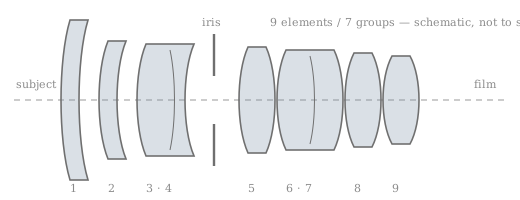
History
Nikon’s account of this lens is a story about time. Development ran for about five years and through two prototypes before the target performance was reached — Shimizu Yoshiyuki was designing against sagittal coma flare, the aberration that turns a point of light in the corner of a fast wide-angle into a smear, and against the retrofocus distortion that comes with putting a 35mm lens far enough in front of the film to clear an SLR mirror. Nine elements in seven groups, two cemented pairs straddling the diaphragm, and the close-range correction scheme first used on the 24mm f/2.8, so that a rear group moves independently and the lens does not fall apart at three feet.
What arrived in 1970 was the fastest 35mm lens made, and the first Nikkor to carry Nikon Integrated Coating. That second fact is easy to miss, because the lens does not say so. Nikon did not begin engraving ·C on multicoated lenses until 1973, so the earliest multicoated Nikkor in existence is marked plain NIKKOR-N AUTO. Vink’s database records the 1970 production as multicoated from the first block.
The early lenses have a second, less welcome distinction. To reach the refractive indices the design wanted, Nippon Kogaku used thorium-bearing glass, standard practice in the 1960s and radioactive. Those elements have gone amber, and a pre-1975 example will cast yellow across a colour slide. The thorium disappears in December 1975: Vink marks the New-Nikkor block “No Thorium”, and separates it from everything before it with the line he reserves for a genuine optical variant rather than a new batch. Nikon’s essay credits a redesign by Tsunashima Teruyoshi in the same period. The layout stayed at nine elements in seven groups; the glass did not. Anyone comparing a Nikkor-N Auto with an Ai-S is therefore not comparing two barrels around one optic, whatever the specification tables imply.
The rest is a long tail. Nine blades gave way to seven in 1973 and came back in 1981. The f/22 stop vanished at the Ai conversion — a correspondent published by Photography in Malaysia reports that the aperture ring fouls the meter-coupling lever of an Ai body at that setting, which would explain a deletion that otherwise looks like a downgrade. Three tiny batches went to NASA with oversize footage scales and metal focus rings: nineteen, sixteen, and thirty-one lenses, each numbered from 1001.
Adding Vink’s blocks gives roughly 134,000 manual-focus examples across fifty years, of which about 94,000 are Ai-S. Nikon never made an autofocus version of this optic; the AF-S 35mm f/1.4G of 2010 is ten elements in seven groups and a separate design, which Vink files as a new family rather than a new variant. What no source supplies is a list price, in yen or dollars, for any version — nor a factory production figure to check the serial arithmetic against.
This history is AI-written, from the sources listed at the foot of the page. Where the record is silent it says so rather than filling the gap — but no human wrote these sentences.
Example photos


Sample photo wanted — shot with a Nikkor 35mm f/1.4? We'd love to feature it (with credit).
Live listings
Asking price, USD: a median of $380 across 36 fixed-price listings on 2026-09-11 (middle half $340–$440). Tracked since 2026-09-06, 2 days: unchanged from $380.
By day
| Date | Median | Middle half | Listings |
|---|---|---|---|
| 2026-09-11 | $380 | $340–$440 | 36 |
| 2026-09-06 | $380 | $340–$450 | 36 |
Asking prices from the listings scanned, not sales; junk-flagged rows and auction lots excluded; other currencies are not converted.
- Read [EXC+5] Nikon F Early Photomic 35mm SLR Film Nikkor 50mm F1.4 From JAPAN
- [Near MINT] Nikon FE Silver 35mm SLR Camera Nikkor 50mm f1.4 AI Converted JAPAN
- Nikon FE Black 35mm SLR Film Camera Ai Nikkor 50mm f/1.4 Tested From JAPAN
- [Near MINT] Nikon FE 35mm Film Camera SLR Ai Nikkor 50mm f1.4 Lens From JAPAN
- Nikon Nikkor-N Auto 35mm f/1.4 Non Ai Wide Angle Lens
- [Exc +5] Nikon Non-Ai Nikkor-N AUTO 35mm F1.4 From JAPAN
- Nikon Nikkor N 35mm f1.4 lens Non AI
- Nikon Nikkor-NC 35mm f1.4 Factory AI Converted
- Nikon Ai-s Ais Nikkor 35mm f/1.4 Wide Angle MF Lens Made In Japan Us Seller READ
- [N MINT in Box] Nikon Nikkor-N Auto 35mm f/1.4 Non Ai Wide Angle Lens From JAPAN
- [ EXC4+ ] Nikon NIKKOR 35mm f/1.4 Ai-S AIS Wide Angle Lens from Japan #14743
- [N.Mint] Nikon F Eyelevel 35mm Film Camera Black + NIKKOR-S 50mm f/1.4 3027607
- [EXC+5 w/caps] Nikon Ais Ai-s Nikkor 35mm f/1.4 Wide Angle Lens From JAPAN
- [MINT] Nikon Nikkor-N.C Auto 35mm f1.4 Non AI Wide angle Lens From JAPAN
- [Near MINT] Nikon Ai Nikkor 35mm f/1.4 MF Wide Angle Lens for F Mount From JAPAN
- Mint - Nikon FE 35mm Film Camera with premium Nikkor 50 mm f1.4 [TESTED]
- Nikon Ai Nikkor 35mm f/1.4 Wide Angle Lens for F From Japan #914
- Nikon Ai-S Nikkor 35mm F/1.4 Wide Angle MF Lens From Japan
- [Opt MINT] Nikon Ai Nikkor 35mm f1.4 Wide Angle Prime MF Camera Lens From JAPAN
- [MINT] Nikon NIKKOR-N Auto 35mm f1.4 Ai Converted Wide Angle Lens From JAPAN
Show 77 more listings
- [Near MINT] Nikon Ai NIKKOR 35mm f/1.4 MF Wide Angle Lens for F mount From Japan
- Nikon Nikkor Non Ai 35mm f1.4 Lens Prime AI converted
- [N Mint+++] Nikon Nikkor-N Auto 35mm f/1.4 Ai Converted MF Wide Angle Lens Japan
- Nikon Nikkor Non Ai 35mm f1.4 Lens Prime AI converted
- Nikon NIKKOR 35mm F1.4 Lens Slightly Used Great Condition No Scratches
- Nikon Nikkor Ais 35mm f1.4 Lens Prime SLR
- Rare w/ Box! 【Almost MINT】 Nikon Nikkor-N Auto 35mm F1.4 Non Ai Lens From Japan
- [Near MINT] Nikon Nikkor AIS AI-S 35mm f1.4 Wide Angle MF Lens From JAPAN
- Nikon Nikkor Ais 35mm f1.4 Lens Prime SLR
- [Serviced & Tested] AI Nikkor 35mm f/1.4 Lens Nikon F Mount 0.3m 400g 153
- Video*[N MINT] Nikon Ai-s Ais Nikkor 35mm F1.4 MF Wide Angle JAPAN 1 day ship #1
- SIC [MINT] Nikon Ai-s Ais Nikkor 35mm F/1.4 MF Wide Angle MF Lens From JAPAN
- SIC S/N490xxx[Opt MINT] Nikon Ai-s Nikkor 35mm f/1.4 MF Wide Lens From JAPAN
- [Mint] Nikon Ai-s Nikkor 35mm f/1.4 Wide Angle MF Lens For F Mount From JAPAN
- Nikon Ai-S NIKKOR 35mm f/1.4
- S/N622xxx N MINT Nikon SP Rangefinder 35mm Film Camera Nikkor S 50mm F1.4 JAPAN
- [Fast neuwertig] Nikon Nikomat FTN 35mm SLR mit Nikkor-S Auto 50mm f/1.4 gete...
- Nikon Non Ai NIKKOR-S.C Auto 50mm f/1.4 Standard SLR Objektiv 35mm, Manuell
- [NEUWERTIG] Nikon Nikkor-N.C Auto 35mm f1.4 Non AI Weitwinkelobjektiv aus JAPAN
- [Opt NEUWERTIG] Nikon Ai Nikkor 35mm f1.4 Weitwinkel Prime MF...
- [NEUWERTIG] Nikon NIKKOR-N Auto 35mm f1.4 Ai konvertiertes...
- [N Mint+++] Nikon Nikkor-N Auto 35mm f/1.4 Ai Converted MF Wide Angle Lens Japan
- [Fast neuwertig] Nikon Ai NIKKOR 35mm f/1.4 MF Weitwinkelobjektiv für...
- *NEUWERTIG+++* Nikon Ai Nikkor 35mm F1.4 MF Weitwinkel Prime Objektiv F Mount...
- CLA'd [NEUWERTIG] Nikon Ai Nikkor 35mm f1.4 MF Weitwinkel Prime Objektiv...
- Video*[N NEUWERTIG] Nikon Ai-s Ais Nikkor 35mm F1.4 F Mount MF...
- Selten mit Box! 【Fast NEUWERTIG】 Nikon Nikkor-N Auto 35mm F1.4 Non Ai...
- Lesen! SIC SN/479xxx [NEUWERTIG] Nikon Ai-s Nikkor 35mm f/1.4 MF Wide Objekti...
- Nikkor 35mm f/1.4 AiS - Optically excellent, fully functional
- Très Bon Objectif Fixe Nikon Ai-S NIKKOR 35mm f/1.4 à Mise Au Point Manuelle
- [ NEAR MINT] Nikon Ai-s AiS Nikkor 35mm F1.4 Wide Angle MF Lens F Mount JAPAN
- Nikon Nikkor 35mm f/1.4 Ai, F, #761-1, - GUT -
- Nikon Ai-S NIKKOR 35mm f/1.4 Objectif Fixe Manuel 52mm Alu
- Nikon Ai Nikkor 35mm f/1.4 Excellent Manual Focus Wide Angle F-Mount Vintage
- Video*[NEUWERTIG] SIC Nikon Ai-s Ais Nikkor 35mm F1.4 MF Weitwinkel JAPAN...
- Nikon Ai-s Ais Nikkor 35mm f/1.4 MF Weitwinkelobjektiv [Near Mint] aus Japan ...
- Nikon Ai-S NIKKOR 35mm f/1.4 Objectif Fixe Manuel 52mm Alu
- Nikon Nikkor NC Auto 35mm f1.4 Thorium Objektiv Lens 97505
- [Opt NEUWERTIGE Haube] Nikon Ai-s Ais Nikkor 35mm f/1.4 MF Weitwinkel Prime...
- SIC 600xxx [NEUWERTIG mit HN-3] Nikon Nikkor Ai-s Ais 35mm f/1.4 Objektiv...
- Seltenes *NEUWERTIG in Box* Nikon Ai-s Ais Nikkor 35mm F1.4 MF Wide Prime...
- OBIETTIVO NIKKOR AFS 35MM F1.4 G
- Ausgezeichnete Nikon Ai-S NIKKOR 35mm f/1.4 Festbrennweite Prime Linse
- [TOP MINT] Nikon Ai-S Nikkor 35mm f/1.4 AIS Late S/N 61xxxx MF Wide Lens JAPAN
- OBIETTIVO NIKKOR AFS 35MM F1.4 G
- Ausgezeichnete Nikon Ai-S NIKKOR 35mm f/1.4 Festbrennweite Prime Linse
- ⏯️SIC [Top MINT in Box] Nikon Ai-s Nikkor 35mm f/1.4 MF Wide Lens From JAPAN
- [Unbenutzt in BOX] Nikon Ai-s Nikkor 35mm f/1.4 MF Weitwinkelobjektiv aus JAPAN
- [Near Mint] Nikon Nikomat FTN 35mm SLR Film Camera NIKKOR 50mm f1.4 Lens JP#3171
- Nikon Nikomat EL 35mm SLR Film Camera NIKKOR-S 50mm F1.4 Lens From JAPAN [Exc+5]
- Nikon FE 35mm SLR Film Camera Black with MF-12 Date Back Nikkor 50mm f1.4 SB-15
- Nikon Nikkormat FT-N 35mm SLR Camera with Nikkor-S Auto 50mm f/1.4 Lens
- [MINT] Nikon Nikkor-N.C Auto 35mm f1.4 Non AI Wide angle Lens From JAPAN
- [N Mint+++] Nikon Nikkor-N Auto 35mm f/1.4 Ai Converted MF Wide Angle Lens Japan
- Nikon NIKKOR-N.C Auto 35mm f1.4 Ai Converted Wide Angle Lens JAPAN Near MINT
- [Near MINT] Nikon Ai NIKKOR 35mm f/1.4 MF Wide Angle Lens for F mount From Japan
- *MINT+++* Nikon Ai Nikkor 35mm F1.4 MF Wide Angle Prime Lens F Mount From JAPAN
- Early Model CLA'd [MINT] Nikon Ai Nikkor 35mm f/1.4 Lens F Mount From JAPAN
- Video*[N MINT] Nikon Ai-s Ais Nikkor 35mm F1.4 F Mount MF Wide Angle Lens JAPAN1
- Nikon Nikkor-N Auto 35mm F1.4 Ai
- [Near MINT] Nikon Nikkor AIS AI-S 35mm f1.4 Wide Angle MF Lens From JAPAN
- Rare w/ Box! 【Almost MINT】 Nikon Nikkor-N Auto 35mm F1.4 Non Ai Lens From...
- CLA'd [MINT] Nikon Ai Nikkor 35mm f1.4 MF Wide Angle Prime Lens From JAPAN
- VERY GOOD 【Serviced】 Nikon Ai-S NIKKOR 35mm F/1.4 Prime Lens
- [ NEAR MINT ] Nikon Ai-s AiS Nikkor 35mm F1.4 Wide Angle MF Lens F Mount JAPAN
- [TOP MINT] Nikon Ai-s Ais Nikkor 35mm f1.4 MF Wide Angle Lens From JAPAN 2915655
- SIC [MINT] Nikon Ai-s Ais Nikkor 35mm F/1.4 MF Wide Angle MF Lens From JAPAN
- SIC S/N490xxx[Opt MINT] Nikon Ai-s Nikkor 35mm f/1.4 MF Wide Lens From JAPAN
- Nikon Ai Nikkor 35mm f/1.4 Excellent Manual Focus Wide Angle F-Mount Vintage
- EXCELLENT 【Serviced】 Nikon Ai-S NIKKOR 35mm F/1.4 Prime Lens
- 【NEUWERTIG-】Nikon Ai-s AIS Nikkor 35mm f/1.4 Weitwinkelobjektiv
- ⏯️SIC [ Top MINT in Box ] Nikon Ai-s Nikkor 35mm f/1.4 MF Wide Lens From...
- VERY GOOD 【Serviced】 Nikon Ai-S NIKKOR 35mm F/1.4 Prime Lens
- EXCELLENT 【Serviced】 Nikon Ai-S NIKKOR 35mm F/1.4 Prime Lens
- Nikon FM 35mm SLR Film Camera + Nikkor 50mm f/1.4 Ai-S Lens
- Nikon Nikomat FT2 Black 35mm SLR Film Camera NIKKOR 50mm f/1.4 lens
- 【Serviced】 Nikon Ai NIKKOR 35mm F/1.4 単焦点レンズ
eBay links are affiliate links. If you buy through one, Glass Bodies earns a small commission from eBay at no cost to you. It does not change which listings appear, their prices or their order — those come from the search and the sort described above.
Listings updated 2026-09-11. Links go to the shop or marketplace that carries the item.