Nikkor 200mm f/2 IF-ED
Nippon Kogaku · Nikon F · 1977 · Telephoto, internal focusing
our own findingAlso known as: Ai Nikkor 200mm f/2 ED IF · Ai Nikkor 200mm f/2S IF-ED · AI-S Nikkor 200mm F2 ED-IF · Nikkor 200mm f/2 ED IF AIS · AF-S VR Nikkor 200mm f/2G IF-ED · AF-S Nikkor 200mm f/2G ED VR II · Nikon 200/2 · ニッコール 200mm F2
Variants & identification
| Variant | Mount | Years | Serial ranges | Production |
|---|---|---|---|---|
| Ai Nikkor 200mm f/2 ED IF — first block · Ten elements in eight groups, internal focusing; two ED | Nikon F (Ai) | 1977–1977 | 176111 – 176147 (37) | 37 (Vink)¹ |
| Ai Nikkor 200mm f/2 IF-ED · Ten elements in eight groups, internal focusing; two ED | Nikon F (Ai) | 1977–1982 | 176301? – 177530 (1,230) | 1,230 (Vink)¹ |
| Ai Nikkor 200mm f/2S IF-ED · Ten elements in eight groups, internal focusing; two ED | Nikon F (Ai-S) | 1982–1986 | 178501 – 179160 (660) | 660 (Vink) — the smallest full production block in the family¹ |
| Ai Nikkor 200mm f/2S IF-ED New · Ten elements in eight groups — the 1977 computation, unchanged | Nikon F (Ai-S) | 1986–2005 | 200001 – 201826 (1,826) | 1,826 (Vink) — the longest manual run, nineteen years¹ |
| AF-S Nikkor 200mm f/2G IF-ED VR · Thirteen elements in nine groups, internal focusing; three ED and one Super ED, with a meniscus protective front element | Nikon F (AF-S, G — no aperture ring) | 2004–2010 | 200001 – 202373 (2,373) — June 2004 to 2005 300001 – 303501 (3,501) — the 2006 six-series, to August 2010 | 5,874 across two serial series (2,373 + 3,501 — arithmetic, not a published total)¹ |
| AF-S Nikkor 200mm f/2G ED VR II · Thirteen elements in nine groups — the 2004 computation, recoated | Nikon F (AF-S, G — no aperture ring) | 2010–2020 | 200001 – 205539 (5,539) | 5,539 (Vink) — September 2010 to May 2020¹ |
- The autofocus lens of 2004 is a new optical system rather than the 1977 design motorised: thirteen elements in nine groups with three ED and one Super ED, against ten in eight with two ED for every manual version from 1977 to 2005.
- Vink's quantity column is, in his own words, "Number of lenses made based on serial numbers collected" — spans of numbers he has seen, not factory records. Nikon has published no production figure for any version of this lens.
- Manual-focus production across all four blocks comes to 3,753 lenses in twenty-eight years (37 + 1,230 + 660 + 1,826). That sum is arithmetic performed here. For scale, the Ai Nikkor 105mm f/2.5 of the same period ran 157,333 in four years.
- Two dates are in dispute. Nikon's own account puts general sale of the Ai-S at April 1982 and the New on the market in December 1985; Vink's serial blocks open in January 1982 and December 1986. Both are recorded; neither is preferred here.
- Specification by version, from Vink's table: Ai, 10 elements in 8 groups, f/22, 2.5m, 9 blades, 122mm filter, 128mm × 214mm, 2,400g; Ai-S, the same but 138mm across; Ai-S New, same optics, gelatin filter only, 132mm × 225.5mm, 2,550g, 240° throw; AF-S VR, 13 in 9, 1.9m, 52mm rear filter, 124mm × 203mm, 2,900g; AF-S VR II, the same at 2,930g.
- No list price for any version has been found in the sources consulted, in yen or in dollars.
How to tell them apart
- Two ED elements at the front of every manual version; three ED plus one Super ED on the autofocus lens. The Ai and Ai-S take a 122mm front filter, the same size as the 300mm f/2.8 of the same years, which is part of why the lens is so often taken for one.
- A tripod collar on every version — clamped on for the first thirty-seven lenses, built into the barrel thereafter. A 200mm lens that ships with a collar is saying something about its weight before it is picked up.
- There is no AF or AF-D 200mm f/2. The screw-drive and D generations passed the lens over entirely: the line runs Ai-S to AF-S with an eighteen-year gap in the middle.
Ai Nikkor 200mm f/2 ED IF — first block:
- A clamp-on tripod collar and a detachable HN-18 hood, both replaced within months
- Lens data engraved along the barrel rather than around the front ring
- LENS MADE IN JAPAN in white; five cross-head mount screws
Ai Nikkor 200mm f/2 IF-ED:
- Built-in tripod collar and built-in sliding hood; lens data at the front
- 128mm across the barrel, 214mm from the mount, 2,400g (Vink)
- 122mm front attachment, 2.5m close focus, f/22 minimum, nine blades
Ai Nikkor 200mm f/2S IF-ED:
- The S in the name: Ai-S, with the aperture ridge and the scoop on the mount flange
- 138mm across where the Ai is 128mm (Vink's specification table)
Ai Nikkor 200mm f/2S IF-ED New:
- A protective glass over the front element, added to shield the ED glass
- No 122mm front attachment: filtration moves to a gelatin holder at the rear
- Redesigned hood, 132mm barrel, 225.5mm long, 2,550g, 240° focus throw
AF-S Nikkor 200mm f/2G IF-ED VR:
- No aperture ring at all — a G lens, and the first 200mm f/2 that autofocuses
- 52mm drop-in filter at the rear; nothing screws on the front
- 1.9m close focus against the manual lens's 2.5m; 2,900g; nine rounded blades
AF-S Nikkor 200mm f/2G ED VR II:
- Nano Crystal Coat, and VR printed in gold rather than red
- A three-position AM/MA-M switch where the first VR lens has two
- Ai Nikkor 200mm f/2 ED IF — first block: Vink's lens list marks this block "pre-production". Thirty-seven lenses, dated January 1977, three months before Nikon says volume production began.
- Ai Nikkor 200mm f/2 IF-ED: Nikon dates the launch to April 1977 and says the lens was sold only to the news media at first. Vink's serial block opens the same month.
- Ai Nikkor 200mm f/2S IF-ED: Nikon says general sale — as opposed to sale to the press — began in April 1982 under this name. Vink's block opens in January.
- Ai Nikkor 200mm f/2S IF-ED New: Nikon puts this version on the market in December 1985; Vink's serial block opens in December 1986. The optics are unchanged from 1977.
Serial-range notes
- 176111 – 176147
- Thirty-seven lenses, January 1977, which Vink's lens list marks as pre-production. They carry a clamp-on collar and the detachable HN-18 hood; the production barrel that follows at 176301 has both built in.
- 200001
- The number 200001 opens three separate versions — the Ai-S New in December 1986, the AF-S VR in June 2004 and the AF-S VR II in September 2010. A bare 2000xx serial identifies nothing on its own; the mount and the barrel do.
- 179160 – 200001
- Vink records no lens between the end of the Ai-S block and the start of the New, a gap of nine months on his dates (March to December 1986) and twenty-one on Nikon's.
Specifications
- Formula
- Telephoto, internal focusing
- Construction
- 10 elements / 8 groups
- Aperture range
- f/2–f/22
- Diaphragm blades
- 9
- Min. focus
- 2.5 m
- Dimensions
- 138 × 214 mm
- Weight
- 2400 g
- Years manufactured
- 1977–2020
- Country
- Japan
- Coating
- Nikon's multilayer coating throughout the manual run; Nano Crystal Coat on the AF-S VR II, which is the only coating change Vink's feature column records for this family.
What reviewers say
- Nikon — NIKKOR: The Thousand and One Nights, Tale 31 (blog) — Nikon records the lens as an answer to press photographers who wanted the fastest possible aperture at about 200mm for indoor gymnastics, hand-held. Sharp at full aperture with soft rendition from the shallow depth of focus, improving through f/2.8 to f/4 and uniform from f/5.6 to f/11, with diffraction taking over by f/16.
- Bjørn Rørslett (blog) — He rates the manual lens 5 out of 5 on film and calls it one of Nikon's least known lenses — peak results near f/2.8, a rapid decline past f/5.6, poor results at f/22, and enough flare that the hood is mandatory and ghosts still appear. On the D2X the chromatic aberration is, in his word, quite visible.
- Bjørn Rørslett (blog) — The AF-S VR he rates 5 out of 5 on both DX and FX: sharper, better at resisting ghosts, and smaller than the manual lens it replaced. His complaints are the tripod collar, which he calls inefficient and flexing, and VR degrading sharpness on a tripod despite Nikon's claims.
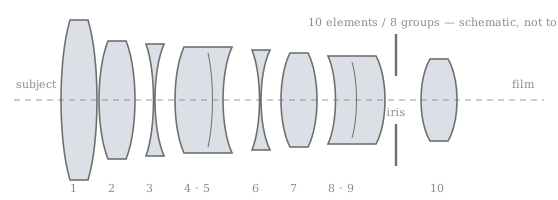
Optical formula — Telephoto, internal focusing
History
Press photographers asked for a specific thing: about 200mm, the fastest aperture obtainable, and light enough to hold. Gymnastics was the event that drove it — indoors, badly lit, and unforgiving of a slow shutter. Nippon Kogaku’s answer took until 1976 to compute and reached the news agencies in April 1977, and for the next twenty-seven years nothing else at 200mm opened to f/2.
The design was Kiyoshi Hayashi’s, and it was the first lens he had ever done. Nikon’s account of it is unusually specific about method: no design automation, calculators far short of a computer, and a hand-built numerical table showing how each aberration moved when a curvature or a spacing was nudged. The structural decision was the second group. Three elements at the front, two of them ED, do the chromatic and spherical correction; a concave group of three behind them provides both the telephoto ratio and the focusing movement. A stronger concave group would have shortened the lens further at the cost of aberration drift at close range, and Hayashi declined to take it — a 200mm lens does not need a big telephoto ratio. The last group ends in a concave element whose job is the Petzval sum, without which the design would not cover the field.
For five years it was not a catalogue item. Nikon says general sale opened in April 1982, under the name Ai Nikkor 200mm f/2S IF-ED; Roland Vink’s serial blocks open in January of that year. The disagreement repeats at the other end, where Nikon puts the New version on the market in December 1985 and Vink’s numbers start in December 1986. Both dates are recorded above and neither is preferred.
What the serial blocks make plain is how few there were. Thirty-seven pre-production lenses, then 1,230, then 660, then 1,826 across nineteen years: 3,753 manual-focus lenses in total, by arithmetic on Vink’s collected numbers rather than by any published figure. The Ai Nikkor 105mm f/2.5 sold more than forty times that in a seventh of the time. Bjørn Rørslett, who rates the lens 5 out of 5, calls it one of Nikon’s least known, and the production span is why.
Then the line stops. Nikon built AF and AF-D versions of almost everything, and never built one of these; the 200mm f/2 sat out the screw-drive era completely and returned in June 2004 as the AF-S VR, thirteen elements in nine groups with three ED and a Super ED, no aperture ring, and a filter slot moved to the rear. It is a different lens wearing the same specification. Whether the manual design was simply too heavy for a body-driven screw to swing, or whether the sales of 660 and 1,826 lenses made the case for themselves, is not something any source consulted says. Nor has a list price surfaced for any version, in yen or in dollars, so what a news agency actually paid in 1977 for the world’s fastest 200mm remains unrecorded here.
This history is AI-written, from the sources listed at the foot of the page. Where the record is silent it says so rather than filling the gap — but no human wrote these sentences.
Example photos
Sample photo wanted — shot with a Nikkor 200mm f/2 IF-ED? We'd love to feature it (with credit).
Live listings
Asking price, USD: a median of $1,600 across 4 fixed-price listings on 2026-09-06 (middle half $950–$1,700). First day tracked.
Asking prices from the listings scanned, not sales; junk-flagged rows and auction lots excluded; other currencies are not converted.
- Zirkularer Polarisationsfilter für Nikon AF-S Nikkor 200mm f/2 VR G IF-ED, Ø
- UV Schutzfilter Nikon AF-S Nikkor 200mm f/2 VR G IF-ED Sperrfilter Ø 52mm
- Schutzfilter 52mm für Nikon AF-S Nikkor 200mm f/2 VR G IF-ED
- Nikon Ai/S Nikkor 2,0/200 IF ED Teleobjektiv - MF Tele Lens - 200mm F/2 Ai-S
- Nikon Nikkor AF-S 200mm f2 G ED SWM VR IF Lens AFS *Inoperable #615
- Nikon Nikkor 200mm IF ED Ai-S f/2 with Case Serial #178581
- Nikon Nikkor AF-S 200mm f2 G ED SWM VR IF Lens AFS w/RRS Tripod Foot *Read #263
- Nikon AF-S NIKKOR 200mm f/2G ED VR II Super Telephoto F Mount from Japan D0814
eBay links are affiliate links. If you buy through one, Glass Bodies earns a small commission from eBay at no cost to you. It does not change which listings appear, their prices or their order — those come from the search and the sort described above.
Listings updated 2026-09-05. Links go to the shop or marketplace that carries the item.