Micro-Nikkor 55mm f/3.5
Nippon Kogaku · Nikon F · 1961 · Xenotar type
our own findingAlso known as: Micro-Nikkor 5.5cm f/3.5 · Micro-Nikkor Auto 55mm f/3.5 · Micro-Nikkor-P Auto 55mm f/3.5 · Micro-Nikkor-P·C Auto 55mm f/3.5 · Micro-Nikkor-P.C Auto 55mm f/3.5 · Micro Nikkor P C Auto 55mm f3.5 · Micro-Nikkor 55mm f/3.5 K · New Micro-Nikkor 55mm f/3.5 · Ai Micro-Nikkor 55mm f/3.5 · Nikon Micro 55mm f/3.5 · MICRO-NIKKOR 1:3.5 f=55mm · マイクロニッコール 55mm F3.5
Variants & identification
| Variant | Mount | Years | Serial ranges | Production |
|---|---|---|---|---|
| Micro-Nikkor 5.5cm f/3.5 — preset | Nikon F (pre-AI, preset aperture) | 1961–1963 | 171501 – 172572 — first block, from August 1961; filter thread flush with the barrel 172714 – 173821 — second block, to 1963; filter thread raised | 2,321 for the whole 5.5cm run — Vink hangs the quantity on the second block, and 173821 minus 171501 plus one gives the same figure¹ |
| Micro-Nikkor Auto 55mm f/3.5 — compensating aperture | Nikon F (pre-AI, meter prong) | 1963–1969 | 188101 – 209525 (21,425) — chrome barrel, feet or metres, from March 1963 211001 – 227335 (16,335) — black barrel, scalloped aperture ring, from December 1966 238011 – 273153 (35,143) — takes Ai conversion kit 63; from 1968, and the last block is marked in feet and metres together | 72,903 across the three blocks — arithmetic on Vink's quantities, not a published total¹ |
| Micro-Nikkor-P Auto 55mm f/3.5 — non-compensating | Nikon F (pre-AI, meter prong) | 1969–1973 | 600001 – 620815 (20,815) — front ring engraved NIPPON KOGAKU JAPAN, 1969 to 1971 630001 – 728469 (98,469) — front ring engraved NIKON, 1971 to 1973 | 119,284 across the two blocks — arithmetic¹ |
| Micro-Nikkor-P·C Auto 55mm f/3.5 — multicoated | Nikon F (pre-AI, meter prong) | 1973–1975 | 730001 – 811928 (81,928) — 1973 to March 1975 | 81,928 |
| Micro-Nikkor 55mm f/3.5 (K) | Nikon F (pre-AI, meter prong) | 1975–1977 | 850001 – 925206 (75,206) — January 1975 to 1977 | 75,206 |
| Ai Micro-Nikkor 55mm f/3.5 | Nikon F (Ai) | 1977–1979 | 940001 – 948681 — engraved PK-3.13, from 1977 949786 – 980534 — engraved PK 975449 – 992480 — barrel engraving changes from LENS MADE IN JAPAN to MADE IN JAPAN 991581 – 1106077 — three cross-head mount screws where the earlier Ai barrels have five; to October 1979 | 166,077 for the Ai run as a whole; Vink gives no separate quantity for the four sub-blocks within it |
- Vink's quantity column is, in his own words, "Number of lenses made based on serial numbers collected" — derived from observed serial spans, not from factory records. Sums across blocks are arithmetic performed here and are marked as such wherever they appear.
- Nikon's own account dates the F-mount lens by its prototype drawings (October 1960), start of mass production (January 1961) and release (August 1961); Vink's first serial block opens at August 1961. The two agree.
- Nikon's Tale 85 says the optical system went "about 19 years" without change, from 1961 to the arrival of the f/2.8. Vink's blocks run August 1961 to October 1979, which is eighteen years and two months. The claim and the serial evidence are consistent to within a rounding.
- Nikon dates the arrival of the non-compensating Micro-Nikkor-P Auto to 1970. Vink's first Micro-P serial block opens in 1969. The gap is one year and neither source acknowledges the other; the serial evidence is the more granular, and the compensating run is closed at 1969 here on that basis.
- No list price for any version of this lens has been found in the sources consulted, in yen or in dollars.
How to tell them apart
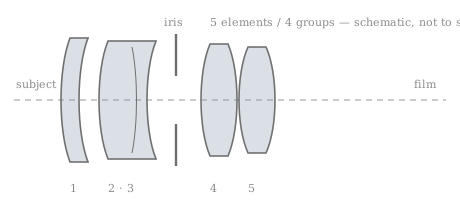
- Five elements in four groups on every version from 1961 to 1979. Nothing optical changed in eighteen years; everything that changed was mechanical, and every change is legible on the barrel.
- 52mm filter throughout, and the HN-3 hood throughout
- Preset or automatic in one look: a preset ring and a 660° focus throw is the 5.5cm; a meter prong and a 300° throw is everything after it
- Compensating or not, without dismantling anything: on the 1963–69 lenses the aperture blades visibly open as the barrel is racked out, because the mechanism is holding the effective aperture constant
Micro-Nikkor 5.5cm f/3.5 — preset:
- Preset iris: the ring is set to the working stop and the aperture closed by hand before the exposure
- Reaches 1:1 on its own helicoid. No later 55mm Micro-Nikkor does — every one of them stops at 1:2 and needs a tube
- 660° of focus travel, more than twice the throw of the 1963 lens
- Seven blades, minimum aperture f/22, 325g — all three change at the redesign
- PAT PEND on the barrel with LENS MADE IN JAPAN in white on the focus ring (Vink's country column)
Micro-Nikkor Auto 55mm f/3.5 — compensating aperture:
- The compensating linkage: the iris opens as the barrel extends, so the marked f-number stays the working one at close range
- Six blades, minimum aperture f/32, 300° throw, 240g
- Stops at 1:2 alone; 1:1 needs the matching M ring, sold with the lens as a kit
Micro-Nikkor-P Auto 55mm f/3.5 — non-compensating:
- No compensating linkage. Through-the-lens metering had made it pointless, and the mechanism was deleted rather than improved
- Rubber focus grip in place of the metal scallops — it arrives here, six years before the K generation brought it to the rest of the line
- P is the element-count letter (Pente, five); the optics are the 1961 computation untouched
Micro-Nikkor-P·C Auto 55mm f/3.5 — multicoated:
- ·C after the P: multicoated, and the only change from the version before it
- 235g, the lightest of the family
Micro-Nikkor 55mm f/3.5 (K):
- PK-3 engraved on the barrel — the extension ring that takes it to 1:1, named on the lens so the user cannot buy the wrong one
- Takes Ai conversion kit 62 where the Micro-P took kit 63
- Still pre-AI: a meter prong and no Ai ridge
Ai Micro-Nikkor 55mm f/3.5:
- Ai ridge on the aperture ring and the second, small aperture scale for the finder readout
- The last version. The f/2.8 that replaced it in December 1979 is a different optical design, not a further variant
Serial-range notes
- 171501 – 173821
- The entire 5.5cm preset run, two barrel versions inside it, separated by whether the filter thread stands proud of the front ring. 2,321 lenses against 517,719 for the family — the preset is the rarest thing here by two orders of magnitude.
- 554001 – 554003
- Three lenses Vink records as a 55mm f/4 UV prototype that "looks like 55/3.5 micro", dated 1964. A three-element, three-group design and not this lens; Vink notes only the resemblance of the barrel.
- 600001
- The Micro-P block opens a new six-digit series rather than continuing from 273153. Nikon restarted the numbering at the change to non-compensating aperture, so serial order does not run continuously across the family.
- 975449 – 992480
- Ai barrels overlap here: the LENS MADE IN JAPAN engraving and the MADE IN JAPAN engraving are both recorded in this band, and the mount-screw count changes from five to three at about 991581. Serial number alone does not separate late Ai barrels.
Specifications
- Formula
- Xenotar type
- Designed by
- Wakimoto Zenji (脇本善司) — computed the Xenotar-type optical system · Azuma Hideo (東秀夫) — worked with Wakimoto on the original rangefinder computation
- Construction
- 5 elements / 4 groups
- Aperture range
- f/3.5–f/32
- Diaphragm blades
- 6
- Min. focus
- 0.241 m
- Dimensions
- 66 × 55 mm
- Weight
- 240 g
- Filter
- 52 mm
- Years manufactured
- 1961–1979
- Country
- Japan
- Coating
- Single-coated to 1973; multicoated from the Micro-Nikkor-P·C of that year
What reviewers say
- Nikon — NIKKOR: The Thousand and One Nights, Tale 85 (blog) — Nikon credits Zenji Wakimoto with the Xenotar structure and explains the 5.5cm focal length as forced by the F's flange distance, since the 5cm rangefinder lens "could not be used with the Nikon F mount without doing so"; it describes the compensating mechanism as one "that opened the aperture blades so that the effective aperture value does not change in accordance with the shooting distance", and says the same optics and basic design survived for nearly twenty years.
- Richard Haw (blog) — Sharp wide open with resolution that "can still out-resolve most modern sensors on the market today", chromatic aberration he calls as-good-as-none, a flat field suited to copy work, and strong flare resistance from the deeply recessed front element; he calls the build perfect and recommends it without reservation.
- Richard Haw (blog) — On the 5.5cm preset: resolution "is nice for its time" with good saturation and contrast but visible chromatic aberration just outside the plane of focus, and a preset iris that has to be stopped down by hand before every frame — the handling that ended its two-year run.
- James Tocchio (Casual Photophile) (blog) — Sharpness and resolution are the lens's signature strengths — quite sharp at f/3.5 and blindingly sharp stopped down, with high contrast and vivid colour; bokeh he rates only average, and the need for the matching extension ring to reach 1:1 is a real limitation.
Optical formula — Xenotar type
History
One optical design, eighteen years, six barrels. The glass in an Ai Micro-Nikkor 55mm f/3.5 of 1979 is the glass Zenji Wakimoto computed for a rangefinder in 1956 — a Xenotar type, five elements in four groups — lengthened by five millimetres so it would clear a mirror. Nikon says the change of focal length was not a matter of taste: the 5cm lens “could not be used with the Nikon F mount without doing so”, the flange distance being what it is. Everything else that happened to this lens between 1961 and 1979 happened to the barrel.
The first version, from August 1961, is the odd one. It has a preset iris — set the working stop on a ring, close it by hand before the frame — and 660 degrees of focus travel, and with all of that travel used it reaches life size on its own helicoid, which no later 55mm Micro-Nikkor does. It is also the only one that is rare: 2,321 lenses in two years, against something over half a million for the family. Richard Haw, who has taken most of the line apart, rates its resolution well for the period and notes chromatic aberration just outside the plane of focus; the handling is what killed it.
What replaced it in March 1963 gave up 1:1 to gain an automatic diaphragm, and added the mechanism this lens is remembered for. The compensating aperture opens the blades as the barrel racks out, so that the f-number engraved on the ring stays the f-number reaching the film as magnification rises. Nikon’s own description is exact — an aperture “that opened the aperture blades so that the effective aperture value does not change in accordance with the shooting distance”. It is a clever answer to a real problem, and it lasted six years. Through-the-lens metering measured the light loss directly, and in 1969 the Micro-Nikkor-P arrived with the linkage simply deleted. The rubber focus grip arrived at the same moment, six years before the rest of the Nikkor line got it.
After that the changes are bookkeeping: multicoating in 1973, a new barrel and the PK-3 tube engraved on it in 1975, Ai indexing in 1977. Vink’s blocks give 21,425 and 16,335 and 35,143 for the compensating versions, 20,815 and 98,469 for the Micro-P, 81,928 for the multicoated P·C, 75,206 for the K and 166,077 for the Ai. Added up that is 517,719 lenses, a figure no source publishes and one that should be read as a floor, since Vink counts serials that have been seen rather than serials that were made.
Two things stay open. No list price for any version has been found, in yen or in dollars, so what a photographer actually paid for the compensating mechanism in 1963 — or for its absence in 1969 — is not on the record here. And Nikon restarted the serial numbering at 600001 when the compensating linkage went, rather than continuing from 273153, which means the family’s numbers do not run in one sequence and no source consulted says why the break was made there.
This history is AI-written, from the sources listed at the foot of the page. Where the record is silent it says so rather than filling the gap — but no human wrote these sentences.
Example photos
.jpg)
.jpg)
Sample photo wanted — shot with a Micro-Nikkor 55mm f/3.5? We'd love to feature it (with credit).
Live listings
Asking price, USD: a median of $80 across 55 fixed-price listings on 2026-09-11 (middle half $70–$120). Tracked since 2026-09-06, 2 days: unchanged from $80.
By day
| Date | Median | Middle half | Listings |
|---|---|---|---|
| 2026-09-11 | $80 | $70–$120 | 55 |
| 2026-09-06 | $80 | $70–$120 | 56 |
Asking prices from the listings scanned, not sales; junk-flagged rows and auction lots excluded; other currencies are not converted.
- Nikon Nikkor Non-AI 55mm f3.5 Micro Lens #G222
- [Exc+5] Nikon Micro Nikkor P Auto 55mm f/3.5 Macro MF Lens From JAPAN
- Vtg Nikon Micro-Nikkor-P.C. Auto 55mm f/3.5 Lens Manual Focus Macro Lens (Non AI
- Nikon Nikkor Micro 55mm f3.5 (Non-AI) Manual Lens (706xxx) in User Condition
- Nikon Micro-Nikkor-P Auto 55mm F3.5 AI Lens Used Good
- Nikon Micro Nikkor 55mm F3.5 Non AI Mount Lens For SLR Mirrorless Cameras
- Nikon Nikkor-P Micro Focusing Auto 55mm F3.5 Lens -99
- Nikon 55mm f/3.5 Micro-NIKKOR Non AI Manual Focus Lens, Black
- Nikon Micro-Nikkor-P Auto 55mm 1:3.5 Lens f=55mm W/Back Cap
- Nikon Micro-Nikkor-P Auto 55mm 1:3.5 Lens f=55mm w/ End Caps & Case
- Nikon 55mm f/3.5 Micro-NIKKOR-P.C Auto Non AI Manual Focus Lens {52}
- Nikon Non-Ai Micro-Nikkor-P•C Auto 55mm f/3.5 (Manual Focus) Lens #Z-42790
- Nikon Micro-Nikkor 55mm f3.5 Non-AI Macro Lens [GOOD]
- Nikon Non-Ai Micro-Nikkor 55mm f/3.5 (MF, Feet Only Scale) Lens #Z-57756
- Nikon Micro Nikkor-P Auto 55mm f/3.5 Macro MF Lens From JAPAN
- Nikon Micro-Nikkor-P 55mm f3.5 Non-AI Macro Lens [EXC-]
- NIKON MICRO NIKKOR-P AUTO 1:3.5 f=55mm LENS w/ M2 Ring/Cap/Case- Great Condition
- Nikon Micro Nikkor-P.C Auto 55mm f/3.5 Non Ai MF Lens
- Nikon Micro-Nikkor 55mm f3.5 Non-AI Macro Lens [EXC-]
- Nikon Micro Nikkor-P.C Auto 55mm f/3.5 Non Ai MF Lens US Seller in Box
Show 131 more listings
- Nikon Micro-Nikkor 55mm f3.5 Non-AI Macro Lens [EXC+]
- Nikon Micro-Nikkor 55mm f3.5 Non-AI Macro Lens [EXC]
- Nikon Micro-Nikkor 55mm f3.5 Non-AI Macro Lens [EXC+]
- Nikon Micro-Nikkor 55mm f3.5 Non-AI Macro Lens [EXC]
- Nikon Micro NIKKOR P Auto 55mm f3.5 Lens & M2 Extension Tube & Box
- Nikon Micro-NIKKOR-P.C 55mm f/3.5 Non Ai L#751545
- Nikon Micro Nikkor Auto 55mm F/3.5 Non Ai MF "Excellent " From Japan
- [Exc+4] Nikon Micro-NIKKOR-P 55mm F3.5 Non Ai Macro Lens & Caps From JAPAN
- [Exc+5] Nikon Ai Micro Nikkor P.C Auto 55mm f/3.5 MF Macro Lens From JAPAN
- USED Nikon Micro Nikkor 55mm F3.5 Non AI Lens W/ Extension Tube M
- [Near Mint] Nikon AI Micro-Nikkor 55mm f/3.5 Macro Lens w/ PK-13 JAPAN
- [Near MINT+++] Nikon Micro Nikkor-P Auto 55mm f/3.5 Macro MF Lens From JAPAN
- Nikon Ai Micro NIKKOR 55mm f/3.5 MF Macro Lens *Excellent* #5265
- [Near Mint] Nikon Ai Micro Nikkor 55mm F/3.5 MF Macro Lens From JAPAN #ii39
- Micro-Nikkor 55mm f/3.5 Ai Macro Lens
- [Near Mint]Nikon Ai Micro NIKKOR 55mm f/3.5 MF Macro Lens #237
- Nikon Ai Micro Nikkor 55mm f/3.5 MF Macro Lens From JAPAN Near Mint #6745
- Nikon Micro-Nikkor 55mm f3.5
- Nikon Micro NIKKOR P C 55mm f3.5 Lens Excellent Condition F Mount
- Nikon Micro-Nikkor 55mm f/3.5 Macro Lens Tested Clear Glass Vintage FREE SHIP
- Nikon Ai Micro-NIKKOR 55mm f/3.5
- NEAR MINT early Micro Nikkor AI con. 55mm f3.5 Micro Lens Nippon Kogaku NIKON
- Nikon Micro-NIKKOR 55mm f/3.5 Manual Focus Macro Lens Excellent Condition
- [Near MINT] Nikon Ai Micro Nikkor 55mm f/3.5 MF Macro Lens From JAPAN
- *Near Mint ++ w/ Case* Nikon Nikomat FTN Film Camera New Micro Nikkor 55mm F/3.5
- [Near MINT] Nikon Micro-NIKKOR AI 55mm f/3.5 MF Macro Prime Lens Japan #80
- [Near MINT] Nikon Auto Micro-NIKKOR 55mm f/3.5 Macro Lens From JAPAN
- *Near Mint* Nikon Nikomat EL Black Camera Micro Nikkor Auto 55mm F/3.5 Lens /JPN
- [Near MINT] Nikon Auto Micro-NIKKOR 55mm f/3.5 Macro Lens From JAPAN #98
- Nikon Micro-Nikkor 55mm f/3.5 L#212591 Reno
- Nikon Ai Micro-NIKKOR 55mm F3.5 Lens Excellent Condition Macro Photography
- 👉 Nikon Micro Nikkor 55mm f/3.5 Macro Lens AI MF Clean Glass Sharp
- Nikon Nikkormat FT w/ 55mm f/3.5 Micro Nikkor B#3202781 L#220877
- [Exc+5] Nikon F3 EyeLevel 35mm SLR Film Camera Micro Nikkor 55mm F3.5 From JAPAN
- *Rare Almost Mint* Nikon Micro Nikkor 5.5cm 55mm F/3.5 Macro 1:1 Preset Lens 2nd
- Nikon Micro-Nikkor P Auto 55mm F3.5 Lens Box - UK Dealer
- Nikon Micro-Nikkor 55mm f3.5 Non AI Manual Focus Lens From Japan Video [N. Mint]
- [Near MINT] Nikon Micro Nikkor-P Auto 55mm f/3.5 Macro MF Lens From JAPAN
- [EXC] Nikon Micro NIKKOR-P Auto 55mm f/3.5 Manual Focus Lens From Japan 718219
- 【Exc+3】Nikon Micro-Nikkor-PC Auto 55mm f3.5 converted to AI Lens from Japan
- Nikon 55mm f/3.5 Micro-Nikkor-P.C Auto Lens
- Nikon Micro Nikkor 55mm f3.5 Macro Lens + M2 Extension Tube
- Nikon Micro-Nikkor-P.C Auto 55mm f/3.5 Manual Focus Lens 52mm Japan #3061
- 【Top Mint】Nikon Micro NIKKOR 55mm f/3.5 Ai Lens for FE2,FM2,FM3A From...
- 🎦VIDEO👀⭐N MINT⭐ Nikon Ai Micro Nikkor 55mm F3.5 MF Lens From JAPAN
- [Excellent+5] Nikon Ai Micro Nikkor 55mm f/3.5 MF Macro Lens from Japan #8167
- Nikon Micro NIKKOR-P Auto 55mm f/3.5 Non Ai Lens
- 【Tested】Nikon Ai Micro-Nikkor 55mm f/3.5 MF Lens From Japan C-997
- [Near MINT+++] Nikon Micro Nikkor-P Auto 55mm f/3.5 Macro MF Lens From JAPAN
- 【Near Mint】Nikon Ai Micro-NIKKOR 55mm F3.5 Macro Lens for F Mount
- Nikon Ai Micro NIKKOR 55mm f/3.5 MF Macro Lens *Excellent* #5265
- SEHR GUT Nikon Ai Converted Micro Nikkor-P.C Auto 55mm F/3.5 + M2 Verlängerung
- "NEAR MINT" Nikon Micro-NIKKOR-P.C 55mm f/3.5 Macro Lens Ai JAPAN 5532
- Nikon Ai Micro NIKKOR 55mm f/3.5
- Nikon Micro-NIKKOR-P 55mm f/3.5 Prime Lens - Nikon AI Mount
- Nikon Micro Nikkor P Auto 55mm f/3.5 Ai Converted Lens [Excellent from Japan
- Nikon Ai Micro Nikkor 55mm f/3.5 MF Macro Lens From JAPAN Near Mint #6745
- Nikon Micro-Nikkor 55mm f3.5 Non-AI Film Era Macro Lens
- Nikon Micro Nikkor 55mm f3.5 Ai lens manual focus services optics cleaned etc
- EXCELLENT Nikon Ai Micro-NIKKOR 55mm F/3.5 Macro Lens
- EXCELLENT Nikon Ai Micro-NIKKOR 55mm F/3.5 Macro Lens
- NIKON LENS MICRO NIKKOR 55MM f3.5 Used
- Nikon P.C Auto AI 55mm f3.5 Micro-Nikkor Lens. Graded: EXC+ [#11237]
- Nikon Ai Micro-NIKKOR 55mm f/3.5
- Nikon Micro-Nikkor 55mm F 3.5 Manual Focus MACRO Lens AIS No. 1031042. refbj
- [ OPT MINT ] Nikon Ai Micro Nikkor 55mm f3.5 MF Macro Lens F mount From JAPAN
- Nikon 55mm f3.5 Macro/Micro Nikkor Pre-Ai Lens & PK3 Adaptor 1:1 Reproduction
- Nikon Micro‑Nikkor 55mm f/3.5 Non‑AI Macro Lens – Serviced – VGC
- Nikon Micro-NIKKOR 55mm f/3.5 Macro Close Up Objektiv - AI Mount
- 【Top Mint】Nikon Ai Micro Nikkor 55mm f/3.5 Macro Prime Lens from JAPAN...
- Nippon Kogaku Micro-Nikkor-P Auto 55mm F3.5 Cine Mod Prime Lens | Sony E-mount!
- Nikon 55mm f/3.5 Auto Micro-NIKKOR-P Pre-AI Manual Focus Macro Objektiv
- Nikon 55mm F3.5 Auto Micro-NIKKOR-P Pre-AI Manual Focus Macro Close Up Objektiv
- Nikon 55mm f/3.5 Micro-NIKKOR AI Manual Focus Macro Objektiv - Top
- Nikon Micro-Nikkor-P Auto 55mm f/3.5 Pre-AI Lens
- Nikon Micro-Nikkor 55mm f/3.5 Auto AI-Converted Lens
- Nikon Non Ai Micro NIKKOR 55mm F/3.5 MF Macro Prime Lens *As-Is* from Japan #129
- 【Exc+5】Nikon Micro-NIKKOR 55mm f/3.5 Ai Macro MF Prime Objektiv aus Japan...
- Nikon Micro NIKKOR P.C Auto 55mm f3.5 Non-Ai Objektiv aus JAPAN #860
- 🎦VIDEO👀⭐N NEUWERTIG⭐ Nikon Ai Micro Nikkor 55mm F3.5 MF Objektiv aus JAPAN
- Nikon Ai Micro NIKKOR 55mm f/3.5 MF Macro Objektiv *TOP* #5265
- Objectif Reflex Nikon Micro NIKKOR-P Non Ai 55mm f/3.5 Manuel 1
- Nikon Micro Nikkor P-C Auto 55mm f/3.5 #798194
- NIKKOR 55mm f/3.5 MICRO PRE AI Ottimo
- 【Getestet】Nikon Ai Micro-Nikkor 55mm f/3.5 MF Objektiv aus Japan C-997
- Très Bon Nikon Ai Converti Micro Nikkor-P.C Auto 55mm f/3.5 + Tube M2
- Nikon Micro-Nikkor 3,5/55 Objektiv - AI 55mm 1:3.5 Macro Objektiv
- Nikon Micro-Nikkor 3.5/55mm for Nikon Ai mount 2329/158
- "NEAR MINT" Nikon Micro-NIKKOR-P.C 55mm f/3.5 Macro Objektiv Ai JAPAN 5532
- "NEAR MINT" Nikon Micro-NIKKOR-P.C 55mm f/3.5 Macro Objektiv Ai JAPAN 5532
- Nikon 55mm f3.5 micro Nikkor AI (perfect condition)
- Nikon - Micro Nikkor-P•C 55mm f/3.5
- Nikon Micro-Nikkor 3,5/55 Objektiv - AI 55mm 1:3.5 Macro Objektiv
- Objectif Macro Nikon Ai Micro-NIKKOR 55mm f/3.5 Monture Nikon F
- Objectif Macro Nikon Ai Micro-NIKKOR 55mm f/3.5 Monture Nikon F
- Nikon Micro-Nikkor-P C Auto 55mm F3.5 Objektiv für Nikon F-Mount - Fachhändler -
- NIKON MICRO NIKKOR-P.C 55MM F3.5 Macro Objektiv
- Nikon micro NIKKOR Auto 55mm f/3.5 non-AI, Nikon F
- ✮ Nikon Micro-Nikkor-P Auto 55mm f/3.5 #690860 || vom Händler!
- EXCELLENT Nikon Non Ai Micro Nikkor-P Auto 55mm f/3.5 Prime Objektiv
- Nikon Micro-Nikkor - P.C Auto 55mm f/3.5 + Bague M2
- EXCELLENT Objectif Prime Nikon Micro Nikkor-P 55mm F/3.5 Non Ai
- Nikon Micro-NIKKOR-P Auto 1:3.5 f=55mm (Seriennr. 718464) – Vintage Makro-Objekt
- Nikon MF Micro Nikkor 55mm 3.5 AI Makro Objektiv Vollformat Gewährleistung 1Jahr
- 【Top Neuwertig】Nikon Ai Micro Nikkor 55mm f/3.5 Macro Prime Objektiv aus...
- Excellent Nikon F Soufflet Mise au Point Model II + Micro-NIKKOR 55mm f/3.5
- Nikon Micro-Nikkor 55mm f/3.5 AI
- [AS NEW] Nikon Micro-Nikkor 55mm f/3.5 AI Macro Lens
- Nikon F Micro- Nikkor 55mm 1:3.5 Objektiv
- Nikon Micro-NIKKOR-P Auto 55mm f/3.5
- [Top NEUWERTIG in Box] Nikon Nikkor-P.C. Micro 55mm F/3.5 mit TC-200 M2 MF...
- EXCELLENT Nikon Ai Micro-NIKKOR 55mm F/3.5 Makroobjektiv Nikon F
- EXCELLENT Nikon Ai Micro-NIKKOR 55mm F/3.5 Makroobjektiv Nikon F
- EXCELLENT Nikon F Balg Fokussieraufsatz Modell II + Micro-NIKKOR 55mm f/3.5
- Nikon Micro NIKKOR 55mm 1:3.5 vom Fotofachhändler
- Nikon Micro-Nikkor-P C 55mm 1:3.5 (mit Nikon M2)
- [Exc+3] Nikon F Eye Level Black + Ai Micro-NIKKOR 55mm f/3.5 From Japan #4220
- Nikon Ai Micro-NIKKOR 55mm F/3.5 マクロレンズ
- Nikon 非Ai Micro-NIKKOR-P.C Auto 55mm F3.5 [F]
- Nikon Ai改 Micro Nikkor-P.C Auto 55mm F/3.5 + M2 Extention tube 単焦点レンズ
- Nikon Ai Micro-NIKKOR 55mm F/3.5 マクロレンズ
- Nikon Ai改 Micro Nikkor-P.C Auto 55mm F/3.5 + PK-13 Extention tube 単焦点レンズ
- Nikon FG-20 (Black) + Ai改 Micro-NIKKOR-P.C Auto 55mm F3.5
- Nikon 55mm f3.5 Nippon Kogaku Micro-Nikkor-P.C Auto
- Nikon 55mm f3.5 Micro-Nikkor Auto
- Nikon 55mm f3.5 Micro-Nikkor Auto
- Nikon 55mm f3.5 Micro-Nikkor
- Nikon 55mm f3.5 Micro-Nikkor-P.C Auto AI-converted
- NIKON LENS MICRO NIKKOR 55MM f3.5 Used
- Nikon 55mm F3.5 Micro & M2 extention tube
- Nikon Micro-Nikkor-P 55mm f/3.5 Lens Ai Converted
eBay links are affiliate links. If you buy through one, Glass Bodies earns a small commission from eBay at no cost to you. It does not change which listings appear, their prices or their order — those come from the search and the sort described above.
Listings updated 2026-09-11. Links go to the shop or marketplace that carries the item.