Medical-Nikkor 120mm f/4 IF
Nippon Kogaku · Nikon F · 1981 · Telephoto, internal focusing
our own findingAlso known as: Medical-Nikkor 120mm f/4 IF · Medical Nikkor 120mm F4 · Nikon Medical-NIKKOR 120mm · メディカルニッコール 120mm F4
Variants & identification
| Variant | Mount | Years | Serial ranges | Production |
|---|---|---|---|---|
| Medical-Nikkor 120mm f/4 IF | Nikon F | 1981–1998 | 180041–203260 (Vink dates the block February 1981 – 1998) | 23,220 (Vink) |
- Nikon dates the release to December 1981, and its Japanese text is specific about it — the year-end, with the New Year close. Vink's serial block opens in February 1981, ten months earlier. That is the largest gap between a stated release and a serial-block opening anywhere in this family of lenses, and no source reconciles the two.
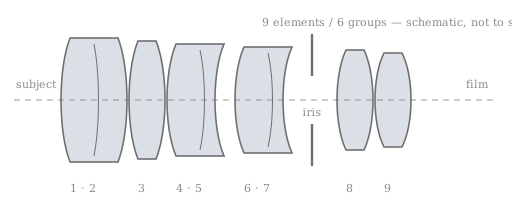
- Nine elements in six groups is the prime lens alone, as given in Nikon's instruction manual and by Vink. The convex–concave–convex arrangement is a telephoto one, focused internally by the middle group. The detachable 2× attachment lens is achromatic and adds a further two elements in one group on top of the prime.
- The instruction manual gives the picture angle as 20°30'; Vink gives 18°50'. Both are published figures and neither is argued for.
- 23,220 is Vink's arithmetic on the serial span. Nikon has published no production figure and no list price for this lens, and it has no discontinued-product page on Nikon's site.
- The Medical-Nikkor Auto 200mm f/5.6 of December 1962 is the first-generation lens and a different design entirely: four elements in four groups, no internal focusing, and a ringlight fed from the same kind of external supply.
How to tell them apart
- Focus and aperture move together on a guide-number system: f/4 at 1:11, f/32 at life size, and nothing the photographer can do about it
- A green LED and a small optical system near the mount project the reproduction ratio into the finder and imprint it on the film at the moment of exposure
- A 12V focusing lamp at the front that glows for sixteen seconds after the button is released
- Internal focusing — the barrel does not extend across the whole 1:11 to 1:1 range
Medical-Nikkor 120mm f/4 IF:
- A ringlight built into the front of the barrel, not an accessory clamped to it
- Four-pin power socket on the barrel for the LA-2 mains unit or the LD-2 battery pack
- 49mm filter thread at the front of a lens 98mm across
- No independently settable aperture ring — focus and diaphragm are coupled
- Medical-Nikkor 120mm f/4 IF: The only version. The lens was current for seventeen years and Vink records no sub-versions, no coating change and no second serial block.
Serial-range notes
- 180041–203260
- One block for the whole run. Vink's start number 180041 sits below his earliest confirmed sighting of 180111.
Specifications
- Formula
- Telephoto, internal focusing
- Designed by
- Iizuka Yutaka (飯塚豊) — optical design
- Construction
- 9 elements / 6 groups
- Aperture range
- f/4–f/32
- Diaphragm blades
- 7
- Min. focus
- 0.35 m
- Dimensions
- 98 × 142 mm
- Weight
- 890 g
- Filter
- 49 mm (0.75 mm pitch)
- Years manufactured
- 1981–1998
- Country
- Japan
What reviewers say
- Dennis Bodzash (blog) — "This lens can only do micro and nothing else ... it does extremely well": solid metal from the 1980s and 2:1 with the thread-on adapter, which no current Nikon macro offers. The built-in ring flash may be unrepairable a quarter-century after production ended, and at maximum magnification f/32 runs into diffraction.
Optical formula — Telephoto, internal focusing
History
Nikon’s Instruments Division sold microscopes to hospitals, and hospitals asked it for something else: a way to record an operation, or a mouth, or a research specimen, accurately and without a photographer getting in the way. The answer was the Medical-Nikkor Auto 200mm f/5.6, drawn for trial production in January 1962, in mass production by May and on sale that December — four elements in four groups, conceived when the Nikon F was three years old and the 43-86mm zoom did not yet exist. It was revised twice, cosmetically in 1972 and for multicoating in 1974, and it stayed on the price list for seventeen years.
The replacement was assigned to Iizuka Yutaka, who had been designing a telephoto zoom immediately before it, and the lens shows where his head was. What he built is a convex-concave-convex arrangement in the shape of a telephoto zoom’s master group, with the concave group doing the focusing the way an internal-focusing super-telephoto does — a zoom’s variator repurposed to change magnification without moving the front of the lens. The mechanics of magnification by zooming and magnification by focusing are nearly the same problem; the difference is whether the distance from subject to film is allowed to change. Sato, who tells the story, notes drily that anyone who looks at the cross-section and sees a telephoto zoom is paying attention.
The focal length was not the first choice. Records show trial drawings issued in 1979 with the length changed from 105mm to 120mm, and Iizuka, asked about it years later, could only say that 120mm gave the right working distance. That is the constraint the whole lens is built around. It focuses from 1.6m down to 0.35m for ratios from 1:11 to life size, and from 0.33m to 0.26m with the 2× attachment screwed on, and all of those distances are long enough to keep the camera out of the surgeon’s way.
Almost nothing about the lens is under the photographer’s control, and that is deliberate. The ringlight is built into the front and fires at a fixed guide number; once the film speed is set on the ASA/ISO ring, the diaphragm is geared to the focusing ring, so the aperture is whatever the reproduction ratio requires — f/4 at 1:11, f/32 at life size, f/32 throughout with the attachment fitted. A green LED and a miniature optical system inside the barrel throw the reproduction ratio into the bottom right of the viewfinder, where it doubles as the flash ready-light, and print it onto the film at the instant of exposure. A 12V lamp at the front lights the subject for sixteen seconds so the focus can be found. Power comes from an LA-2 mains unit or an LD-2 pack of eight AA cells, through a four-pin socket, and without one of them the lens does not meter, does not flash and does not imprint.
There was one version and it never changed: 23,220 lenses in a single serial block, by Vink’s arithmetic, against at least 19,217 across the six blocks of the 200mm that preceded it — one of those six carries no quantity, so the older lens’s total is unknown and may be the larger of the two. What is unresolved is when it went on sale. Nikon’s own account is specific — December 1981, the last days of the year — while Vink’s block opens in February 1981, ten months earlier, and neither party explains the other. Beyond that the record is thin in the ordinary ways: no factory production figure, no published price, no discontinued-product page, and two different picture angles in print for the same piece of glass.
This history is AI-written, from the sources listed at the foot of the page. Where the record is silent it says so rather than filling the gap — but no human wrote these sentences.
Example photos
Sample photo wanted — shot with a Medical-Nikkor 120mm f/4 IF? We'd love to feature it (with credit).
Live listings
Asking price, USD: a median of $220 across 21 fixed-price listings on 2026-09-06 (middle half $150–$310). First day tracked.
Asking prices from the listings scanned, not sales; junk-flagged rows and auction lots excluded; other currencies are not converted.
- Nikon Medical-NIKKOR 120mm f/4 IF Macro Lens [Near Mint] Ring Light From Japan
- NIKON MEDICAL NIKKOR 120MM F4 Standard Medium Telephoto Lens
- EXCELLENT medical NIKKOR 120mm F4 IF MF lens
- [EXC+++] Nikon MEDICAL-NIKKOR 120mm F4 Lens only w/Cap MF Lens from Japan 100050
- 〖N.MINT+++〗 Nikon Medical Nikkor 120mm f4 Macro Lens For SLR Camera From JAPAN
- Nikon Medical-Nikkor 120mm F4 Lens e13042
- [Near MINT] Nikon Medical Nikkor 120mm f/4 MF Manual Focus Lens From JAPAN
- [ Near MINT ] Nikon Medical Nikkor 120mm F4 w/ AC Unit LA-2 + SC-22 From JAPAN
- with AC UNIT [Near MINT] Nikon Medical Nikkor 120mm F4 w/LA-2, SC-22 from Japan
- Japan Nikon Medical Nikkor 120mm f/4 MF Lens
- [Near MINT] Nikon Medical Nikkor 120mm F4 Lens w/ AC Unit LA-2 From Japan
- 【EXC+5】 Nikon Medical-NIKKOR 120mm f/4 Lens with AC Unit LA-2 from Japan #453-2
- Nikon Nikkor 120mm F/4 Medical Nikkor W/ Power Pack & Cables
- [EXC+++] Nikon MEDICAL-NIKKOR 120mm F4 Full Set w/Cap MF Lens from Japan 100200
- [MINT] Nikon Medical-Nikkor 120mm F4 IF Macro Lens w/ AC Unit LA-2 From JAPAN
- [ MINT ] Nikon Medical Nikkor 120mm F4 Lens w/ AC Unit LA-2 + SC-22 From Japan
- [Tested and confirmed working, ] Nikon Medical-Nikkor 120mm F4, Accessories
- [ MINT ] Nikon Medical Nikkor 120mm F4 Lens w/ AC Unit LA-2 + SC-22 From Japan
- Nikon medical Nikkor 120mm f:4 lens with cards/IB/BOX, US SELLER "LQQK"
- 【N.MINT】 Nikon Medical-NIKKOR 120mm f/4 Lens with AC Unit LA-2 from Japan #279
Show 4 more listings
eBay links are affiliate links. If you buy through one, Glass Bodies earns a small commission from eBay at no cost to you. It does not change which listings appear, their prices or their order — those come from the search and the sort described above.
Listings updated 2026-09-05. Links go to the shop or marketplace that carries the item.