GN Auto Nikkor 45mm f/2.8
Nippon Kogaku · Nikon F · 1968 · Tessar type, 4 elements in 3 groups
our own findingAlso known as: GN Auto Nikkor 45mm f/2.8 · GN Nikkor 45mm f/2.8 · GN Auto NIKKOR·C 45mm f/2.8 · GN AUTO NIKKOR 1:2.8 f=45mm · Nippon Kogaku GN Nikkor 45mm f/2.8 · GN Nikkor 45mm F2.8 pancake
Variants & identification
| Variant | Mount | Years | Serial ranges | Production |
|---|---|---|---|---|
| GN Auto Nikkor (Nippon Kogaku), nine blades | Nikon F | 1968–1970 | 710101–725535 | Vink gives 23,848 for this and the seven-blade block together, not separately |
| GN Auto Nikkor (Nippon Kogaku), seven blades | Nikon F | 1970–1971 | 725683–733948 | Included in the 23,848 Vink gives for the two Nippon Kogaku blocks together |
| GN Auto Nikkor (Nikon) | Nikon F | 1971–1974 | 740001–746389 | 6,389 (Vink, counted from serials) |
| GN Auto Nikkor·C | Nikon F | 1974–1977 | 760001–773051 | 13,051 (Vink, serial-derived) — the largest single block, and the last |
- Serial blocks and quantities are Roland Vink's. His Qty column is "Number of lenses made based on serial numbers collected" and his dates "may not be accurate" — serial arithmetic, not factory records. Nikon has published no production figure.
- Summing Vink's blocks gives 43,288 lenses across the whole run: 23,848 marked Nippon Kogaku, 6,389 marked Nikon, 13,051 marked ·C.
- The launch date is not settled. Vink dates production from August 1968; Nikon's own history essay says the lens "was released in March of 1969", and Photography in Malaysia puts it "around in 1969", alongside the Fisheye-Nikkor 6mm f/5.6.
- Blade count and picture angle vary by source and by version: Vink records nine blades then seven rounded ones and gives 51°; the Photography in Malaysia specification sheet, drawn from the later lens, gives seven blades and 50°.
How to tell them apart
- The focus ring turns the opposite way from every other Nikkor — the guide-number cam drives the aperture off it
- 20mm from the flange, 31mm overall, 150g: the only pancake Nikon made for the F mount until 2001
- A guide-number scale on the barrel, 10–30 in metres and 32–250 in feet
- Stops down to f/32, which no other fast-ish Nikkor prime of the period did
- No element-count letter in the name: GN sits where Q for four elements would have gone
GN Auto Nikkor (Nippon Kogaku), nine blades:
- Nine aperture blades — the version collectors pay more for
- Barrel reads NIPPON KOGAKU JAPAN
- Ai conversion kits 83, 84 and 85 fit
GN Auto Nikkor (Nippon Kogaku), seven blades:
- Seven rounded blades, shaped to hold a near-circular opening around f/8
- Barrel still reads NIPPON KOGAKU JAPAN
GN Auto Nikkor (Nikon):
- Barrel reads NIKON — the corporate rename, not an optical change
- Five cross-head screws in the mount ring
GN Auto Nikkor·C:
- ·C for multicoating
- GN Auto Nikkor (Nippon Kogaku), seven blades: The blade count drops but the aperture does not get worse: Nikon shaped the seven blades to approximate a circle at the settings a flash user actually reaches. The nine-blade lens is the scarcer one and the more expensive one used.
- GN Auto Nikkor·C: Production ends in March 1977, the month Ai bodies arrive. No factory Ai version of this lens was ever made; Ai'd examples went through Nikon's conversion kits.
Specifications
- Formula
- Tessar type, 4 elements in 3 groups
- Designed by
- Shimizu Yoshiyuki (清水義之) — optical design
- Construction
- 4 elements / 3 groups
- Aperture range
- f/2.8–f/32
- Diaphragm blades
- 9
- Min. focus
- 0.8 m
- Dimensions
- 64 × 31 mm
- Weight
- 150 g
- Filter
- 52 mm (0.75 mm pitch)
- Years manufactured
- 1968–1977
- Country
- Japan
- Original price
- ¥16,500 at release (today ¥61,000) — Nikon's own account calls it an extremely inexpensive Nikkor
What reviewers say
- Richard Haw (blog) — Sharp with strong contrast from f/2.8, minimal vignetting and bokeh smooth enough to contradict the usual complaint about Tessars — and the one thing that stopped him carrying it daily was the reversed focus ring, not the optics. single source, unconfirmed
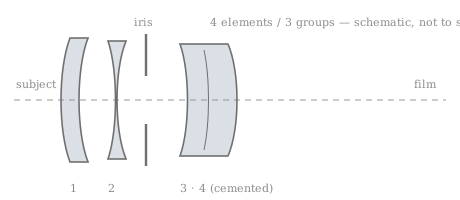
Optical formula — Tessar type, 4 elements in 3 groups
History
Before automatic flash units metered their own light, a flash exposure was arithmetic. Every bulb and every gun carried a guide number; the aperture was that number divided by the distance to the subject; and the photographer did the division at every frame, in the dark, while the subject moved. The GN Auto Nikkor does the division mechanically. Set the flash guide number on a scale on the barrel — 10 to 30 in metres, 32 to 250 in feet — and a non-linear cam links the focus ring to the diaphragm. Focus the lens and the aperture is already right.
The price of that mechanism is the most disorienting handling quirk in the F system: because the cam has to drive the aperture the correct way, the focus ring turns the opposite way from every other Nikkor ever made. Richard Haw, who rates the optics highly, says it is the only reason the lens does not live on his camera. The coupling can be disengaged, and with it off the lens is an ordinary 45mm f/2.8 that meters at full aperture like anything else.
The optics are a Tessar — four elements in three groups, which for Nikon in 1968 was almost an antique choice, and which produced a lens 20mm long and 150 grams heavy that stops down to f/32. Shimizu Yoshiyuki designed it. It and the 45mm f/2.8P of 2001 are the only two Tessar-type lenses Nikon ever made for the F mount, and until that 2001 lens arrived this was the mount’s only pancake.
Nikon was first with the idea and effectively last. Tokyo Kogaku put a guide-number coupling on a Topcor in 1973; Canon tried a different route with the CAT system on the F-1. None of it mattered, because thyristor flash units that read their own light and quenched themselves made the whole calculation disappear. Nikon’s own retrospective is unsentimental about it: flash evolved faster than expected.
Vink’s serial blocks add to 43,288 lenses over roughly nine years, ending in March 1977 — the month Ai bodies arrived, and the reason no factory Ai version exists. What remains open is the start date. Nikon says March 1969; Vink’s records say production ran from August 1968; and Nikon’s own summary of the run as approximately nine years to a 1977 close sits awkwardly with its own release date. Nothing published settles which of the two years belongs to the lens.
This history is AI-written, from the sources listed at the foot of the page. Where the record is silent it says so rather than filling the gap — but no human wrote these sentences.
Example photos

Sample photo wanted — shot with a GN Auto Nikkor 45mm f/2.8? We'd love to feature it (with credit).
Live listings
Asking price, USD: a median of $230 across 45 fixed-price listings on 2026-09-11 (middle half $190–$250). Tracked since 2026-09-06, 2 days: unchanged from $230.
By day
| Date | Median | Middle half | Listings |
|---|---|---|---|
| 2026-09-11 | $230 | $190–$250 | 45 |
| 2026-09-06 | $230 | $190–$250 | 45 |
Asking prices from the listings scanned, not sales; junk-flagged rows and auction lots excluded; other currencies are not converted.
- [Exc2+] Nikon GN Auto NIKKOR C 45mm f2.8 Non Ai MF Pancake Lens From Japan
- Excellent ☆ Nikon GN Auto NIKKOR 45mm F2.8 from Japan 3021039 Pancake lens
- 【EXC】 Nikon GN Auto NIKKOR 45mm F2.8 w/cap FromJapan #yk8287
- Nikon GN Auto NIKKOR C 45mm f/2.8 Pancake Lens (AI-Converted *READ*)
- [ MINT ] Nikon GN Auto Nikkor 45mm f2.8 Non-Ai Pancake MF Lens From JAPAN
- Nikkor GN 45mm f/2.8 Auto Non AI Pancake Lens Nippon Kogaku Japan 45/2.8 Nikon F
- Nikon GN Auto NIKKOR 45mm F/2.8 Pancake lens from Japan [Mint]
- Nikon GN Auto NIKKOR 45mm F/2.8 Pancake lens from Japan [Mint]
- [Near Mint+] Nikon Auto Nikkor GN Nippon Kogaku 45mm f/2.8 MF Manual Lens JAPAN
- [Near MINT] Nikon GN Auto NIKKOR 45mm f/2.8 Compact Pancake Lens / JAPAN
- 【 NEAR MINT++ 】Nikon GN Auto Nikkor C 45mm f/2.8 non-Ai MF Lens From JAPAN #879
- Ai Converted [Near MINT] Nikon GN Auto NIKKOR 45mm f/2.8 MF Pancake Lens JAPAN
- [MINT+++] Nikon GN Auto NIKKOR 45mm f/2.8 Non Ai MF Lens From JAPAN
- Ai Converted🎦👀🌟N MINT🌟 Nikon GN Auto NIKKOR 45mm f/2.8 MF Pancake Lens JAPAN
- [Almost MINT] Nikon GN-Auto Nikkor C non-AI 45mm f/2.8 MF Lens Tested Japan 1024
- [Near MINT] Nikon GN Auto NIKKOR 45mm f/2.8 Compact Pancake Lens From JAPAN
- [TOP MINT] Ai converted Nikon GN Auto Nikkor C 45mm F2.8 Pancake Lens Japan
- [Exc+5] Nikon GN Auto NIKKOR 45mm f/2.8 Lens Nippon Kogaku Japan #7012
- ❀ Top MINT ❀ Nikon GN Auto Nikkor 45mm f/2.8 MF Pancake Prime Lens From JAPAN
- [Near Mint] Nikon GN Auto Nikkor 45mm f/2.8 Non-Ai Pancake MF Lens from JAPAN
Show 80 more listings
- "Top Mint" Nikon GN Auto Nikkor 45mm F/2.8 MF Pancake Non Ai Lens From JP # 2431
- [TOP MINT] Nikon GN Auto NIKKOR 45mm f/2.8 Non Ai MF Lens From JAPAN #394
- EXCELLENT Nikon Non Ai GN Auto Nikkor 45mm F/2.8 Prime Lens
- "MINT+++" Nikon GN Auto Nikkor 45mm f/2.8 Non-Ai Pancake MF Lens From JAPAN
- Vintage Nikon GN Auto Nikkor-C 45mm f/2.8 Pancake Lens F Mount
- [EXC+5] Nikon GN Auto Nikkor 45mm F2.8 Non Ai MF F Mount Lens From JAPAN
- [Mint] Nikon GN Auto Nikkor 45mm f/2.8 Pancake MF Lens Nippon Kogaku Japan
- Nikon GN Auto NIKKOR 45mm f/2.8 Non Ai Lens
- 【Near Mint】Nikon NIKKOR GN Auto 45mm f/2.8 Non-Ai MF Lens w/Cap From Japan 204
- Nikon GN Auto Nikkor 45mm F2.8 - non-AI with packing (94-96%new)
- Near Mint Nikon NIKKOR GN Auto 45mm f/2.8 Non-Ai MF Lens w/Caps From Japan
- [NEAR MINT in Box] Nikon GN Auto Nikkor 45mm f2.8 Non-Ai MF Lens From Japan 1867
- [MINT in Case] Ai converted Nikon GN Auto Nikkor C 45mm f/2.8 Lens From Japan
- "Top Mint+++" Nikon GN Auto Nikkor 45mm f/2.8 Non Ai Pancake Lens From JAPAN
- Nikon GN Auto NIKKOR 45mm f 2.8
- Nikon GN Auto Nikkor 45mm f2.8 Pancake Lens Compact Manual Focus
- Nikon GN Auto NIKKOR 45mm f/2.8 Non Ai Lens
- [Top MINT] Nikon GN Auto Nikkor 45mm f/2.8 MF Lens From JAPAN
- Nippon Kogaku GN Auto Nikkor 45mm F2.8 - non-AI, full packing (97-98%new)
- [Almost Unused w/ Box] Nikon GN Auto Nikkor 45mm f2.8 Pancake Lens From Japan
- Nikon GN Auto NIKKOR 45mm f/2.8 L#719727 In Box
- Nikon GN Auto Nikkor 45mm F/2.8 Non-Ai Lens #60486 A4
- Nikon GN Auto Nikkor 45mm f/2.8 manual-focus lens
- Rare Vintage Nikon GN Auto NIKKOR 45mm F2.8 Pancake Lens with Box
- Nikon GN Auto Nikkor 45mm F/2.8 Non-Ai Lens #63767 A4
- Excellent ☆ Nikon GN Auto NIKKOR 45mm F2.8 from Japan 3021039 Pancake lens
- 【 NEAR MINT++ 】Nikon GN Auto Nikkor C 45mm f/2.8 non-Ai MF Lens From JAPAN #879
- Ai Converted [Near MINT] Nikon GN Auto NIKKOR 45mm f/2.8 MF Pancake Lens JAPAN
- [MINT+++] Nikon GN Auto NIKKOR 45mm f/2.8 Non Ai MF Lens From JAPAN
- [Almost MINT] Nikon GN-Auto Nikkor C non-AI 45mm f/2.8 MF Lens Tested Japan 1024
- Nikon GN Auto Nikkor 45mm f/2.8 Lens – Pre‑AI Pancake – Tested – VGC
- Nikon GN Auto NIKKOR 45mm F/2.8 Pancake lens from Japan [Mint]
- Nikon GN Auto NIKKOR 45mm F/2.8 Pancake lens from Japan [Mint]
- [ MINT ] Nikon GN Auto Nikkor 45mm f2.8 Non-Ai Pancake MF Lens From JAPAN
- Nikkor GN 45mm f/2.8 Auto Non AI Pancake Lens Nippon Kogaku Japan 45/2.8 Nikon F
- ❀ Top MINT ❀ Nikon GN Auto Nikkor 45mm f/2.8 MF Pancake Prime Lens From...
- [Exc+5] Nikon GN Auto NIKKOR 45mm f/2.8 Lens Nippon Kogaku Japan #7012
- EXCELLENT Nikon Non Ai GN Auto Nikkor 45mm F/2.8 Prime Lens
- [EXC+5] Nikon GN Auto Nikkor 45mm F2.8 Non Ai MF F Mount Lens From JAPAN
- [TOP MINT] Nikon GN Auto NIKKOR 45mm f/2.8 Non Ai MF Lens From JAPAN #394
- Ai Converted🎦👀🌟N MINT🌟 Nikon GN Auto NIKKOR 45mm f/2.8 MF Pancake Lens JAPAN
- 9 Blades [ N MINT ] Nikon Nippon Kogaku GN Nikkor 45mm f/2.8 Lens Japan #2847
- [Mint] Nikon GN Auto Nikkor 45mm f/2.8 Pancake MF Lens Nippon Kogaku Japan
- [MINT in Case] Ai converted Nikon GN Auto Nikkor C 45mm f/2.8 Lens From Japan
- Nikon GN Auto NIKKOR 45mm f/2.8 Non Ai Lens
- [Top MINT] Nikon GN Auto Nikkor 45mm f/2.8 MF Lens From JAPAN
- [Almost Unused w/ Box] Nikon GN Auto Nikkor 45mm f2.8 Pancake Lens From Japan
- NIKON GN AUTO NIKKOR C 45mm F2.8 Wide Angle Lens
- Nikon GN Auto Nikkor C 45mm F2.8 Pre-Ai Standard Prime Lens Nikon F + cap
- Nikon GN Auto Nikkor 45mm F/2.8 Non-Ai Lens #60486 A4
- Nikon GN Auto Nikkor 45mm f/2.8 AI Lens
- Ausgezeichnet ☆ Nikon GN Auto NIKKOR 45mm F2.8 aus Japan 3021039 Pancake Obje...
- Objectif Fixe Nikon Non Ai GN Auto Nikkor 45mm f/2.8, Monture Nikon F
- Ai Converted [Near MINT] Nikon GN Auto NIKKOR 45mm f/2.8 MF Pancake Lens JAPAN
- [NEUWERTIG] Nikon GN Auto Nikkor 45mm f2.8 Non-Ai Pancake MF Objektiv aus JAPAN
- [Fast NEUWERTIG] Nikon GN-Auto Nikkor C non-AI 45mm f/2.8 MF Objektiv...
- Nikkor GN 45mm f/2.8 Auto Non AI Pancake Objektiv Nippon Kogaku Japan...
- Nikon GN Auto NIKKOR 45mm F/2.8 Pancake Objektiv aus Japan [Neuwertig]
- Nikon GN Auto NIKKOR 45mm F/2.8 Pancake Objektiv aus Japan [Neuwertig]
- ❀ Top NEUWERTIG ❀ Nikon GN Auto Nikkor 45mm f/2.8 MF Pancake Prime Objektiv...
- [EXC+5] Nikon GN Auto Nikkor 45mm F2.8 Nicht Ai Manuell Objektiv Nikon F
- Ai Converted🎦👀🌟N NEUWERTIG🌟 Nikon GN Auto NIKKOR 45mm f/2.8 MF Pancake Ob...
- [EXC+5] Objectif Nikon GN Auto Nikkor 45mm F2.8 Non Ai Manuel Monture F
- [EXC+5] Nikon GN Auto Nikkor 45mm F2.8 Non Ai MF F Mount Lens From JAPAN
- [EXC+5] Nikon GN Auto Nikkor 45mm F2.8 Obiettivo Non Ai MF Nikon F
- Nikon GN Auto Nikkor C 45mm F2.8 Pancake Objektiv für Nikon F Mount
- [Neuwertig] Nikon GN Auto Nikkor 45mm f/2.8 Pancake MF Objektiv Nippon...
- EXCELLENT Nikon Non Ai GN Auto NIKKOR 45mm f/2.8 Festbrennweite Objektiv
- Selten! Nippon Kogaku GN Auto Nikkor 45mm f/2.8 Objektiv [neuwertig mit...
- [Fast unbenutzt mit Box] Nikon GN Auto Nikkor 45mm f2.8 Pancake Objektiv...
- NIKON GN AUTO NIKKOR C 45mm F2.8 Weitwinkelobjektiv
- Objectif NIKON GN Auto Nikkor f/2.8 - 45mm Pre Ai #729139 avec pare soleil.
- Nikon GN Auto Nikkor 45mm F2.8 Pre-Ai Standard Prime Objektiv mit Haube aus J...
- Nikon 非Ai GN Auto Nikkor 45mm F/2.8 単焦点レンズ
- Nikon 非Ai GN Auto NIKKOR 45mm F2.8 [F]
- Nikon 非Ai GN Auto NIKKOR 45mm F2.8 [F]
- EXCELLENT Nikon Non Ai GN Auto Nikkor 45mm F/2.8 Prime Lens
- [EXC+5] Nikon GN Auto Nikkor 45mm F2.8 Non Ai MF F Mount Lens From JAPAN
- Nikon GN Auto Nikkor 45mm F2.8 - non-AI — SN 764464
- Nippon Kogaku GN Auto Nikkor 45mm F2.8 - non-AI — SN 713766
eBay links are affiliate links. If you buy through one, Glass Bodies earns a small commission from eBay at no cost to you. It does not change which listings appear, their prices or their order — those come from the search and the sort described above.
Listings updated 2026-09-11. Links go to the shop or marketplace that carries the item.